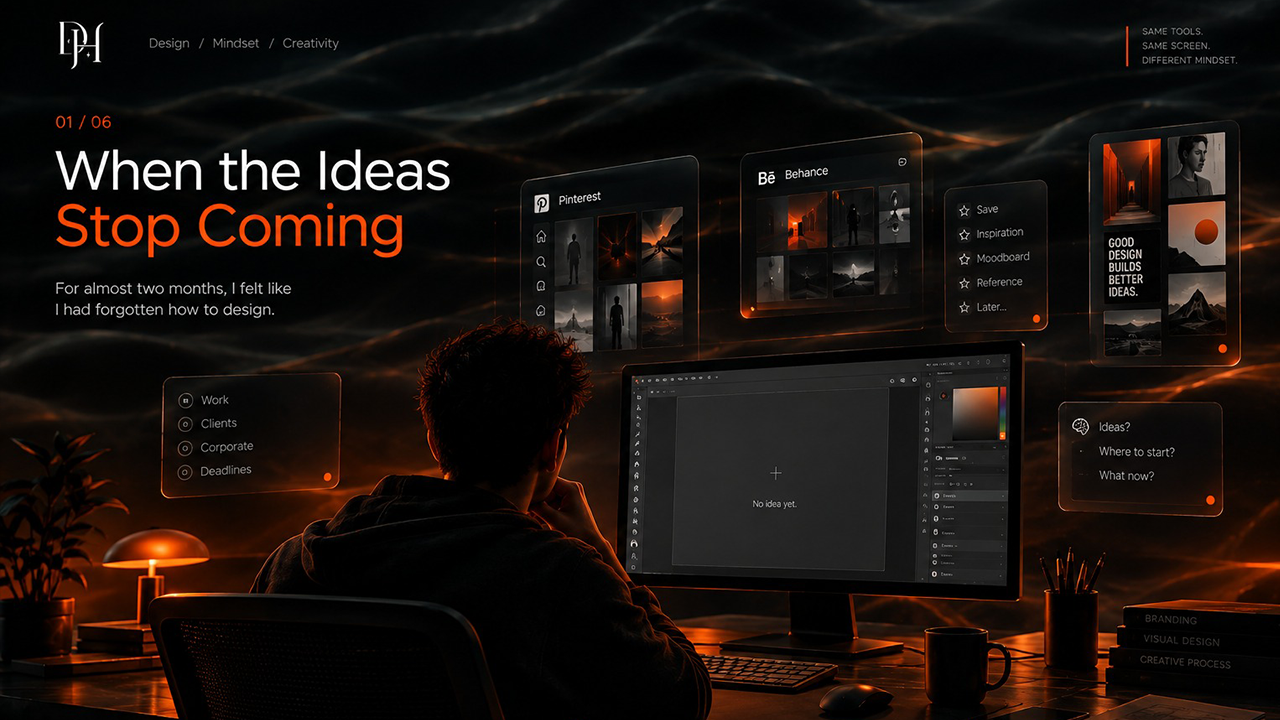
For almost two months, I felt like I had forgotten how to design.
I would open Photoshop, look at the empty canvas, and wait for an idea to come. Nothing.
Then I would open Pinterest.
I would scroll through hundreds of designs. Posters, campaigns, typography, branding projects, social media posts, thumbnails — one beautiful design after another. I would save a few references, tell myself that I had finally found some inspiration, and go back to my screen.
Still nothing.
Then I would move to Behance.
More scrolling. More saving. More inspiration.
And somehow, at the end of the day, I had consumed a huge amount of creativity without creating even one design myself.
That was my first real experience with creative block.
And it wasn’t just about not knowing what to design. It started affecting my actual work. Corporate projects became harder to approach. Client work started feeling heavier. Even simple creative tasks that I would normally finish without thinking too much started feeling like difficult problems.
There was a strange pressure in my head.
I knew I could design.
I had designed before.
So why couldn’t I do it now?
When the Blank Canvas Becomes the Problem
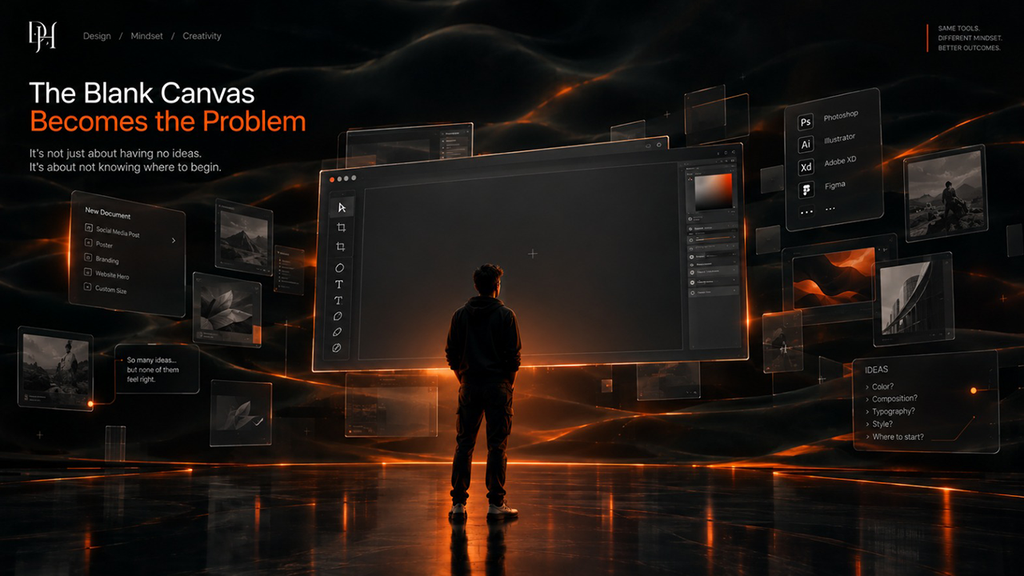
Creative block is strange because, from the outside, it can look like laziness.
You’re sitting at your computer. Your software is open. Your internet is working. You have a brief. You have references.
So what’s stopping you?
For me, it wasn’t that I didn’t want to work.
I wanted to.
I just couldn’t figure out where to begin.
I’d look at the brief and immediately start thinking about the final result. What should the composition look like? Which colors should I use? What kind of image would work? Where should the typography go?
I was trying to solve the entire design before I had even started it.
And that made the blank canvas feel even bigger.
The more I thought about creating something good, the harder it became to create anything at all.
The Pinterest and Behance Trap
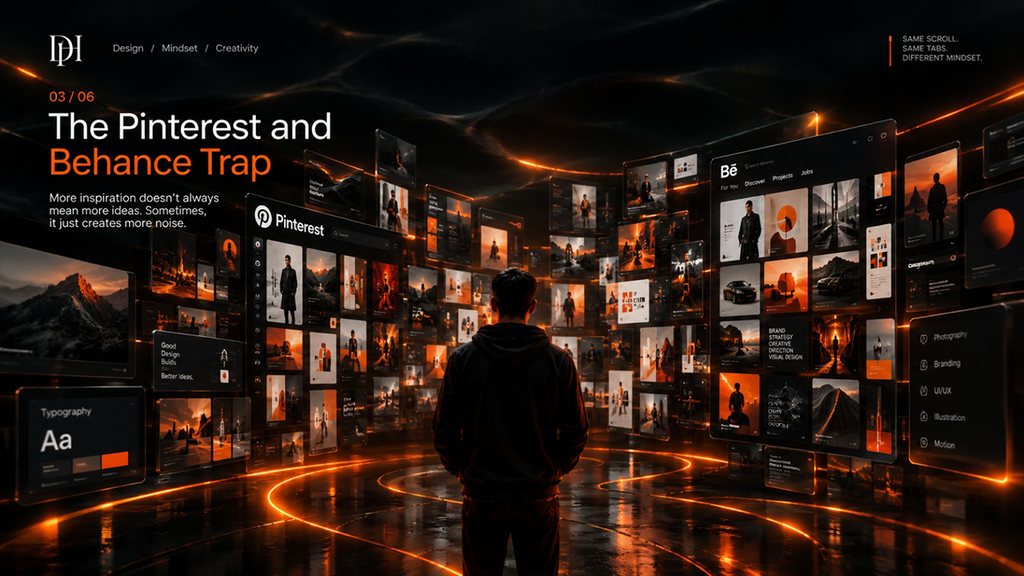
One of the biggest things I learned from that period was that inspiration and creation are not the same thing.
Pinterest and Behance can be incredible resources for designers. I still use them, and there is nothing wrong with looking at other people’s work.
The problem starts when looking for inspiration becomes a substitute for actually creating.
I was constantly consuming.
I thought I was researching.
But sometimes I was just avoiding the uncomfortable part: starting my own work.
I’d see an amazing design and think, “I need to create something like this.”
Then I’d see another one.
And another.
Eventually, I had so many visual directions in my head that choosing one became almost impossible.
Instead of giving me clarity, more inspiration gave me more noise.
That taught me something important:
Sometimes you don’t need more inspiration. You need fewer distractions.
When Creative Block Starts Affecting Your Work
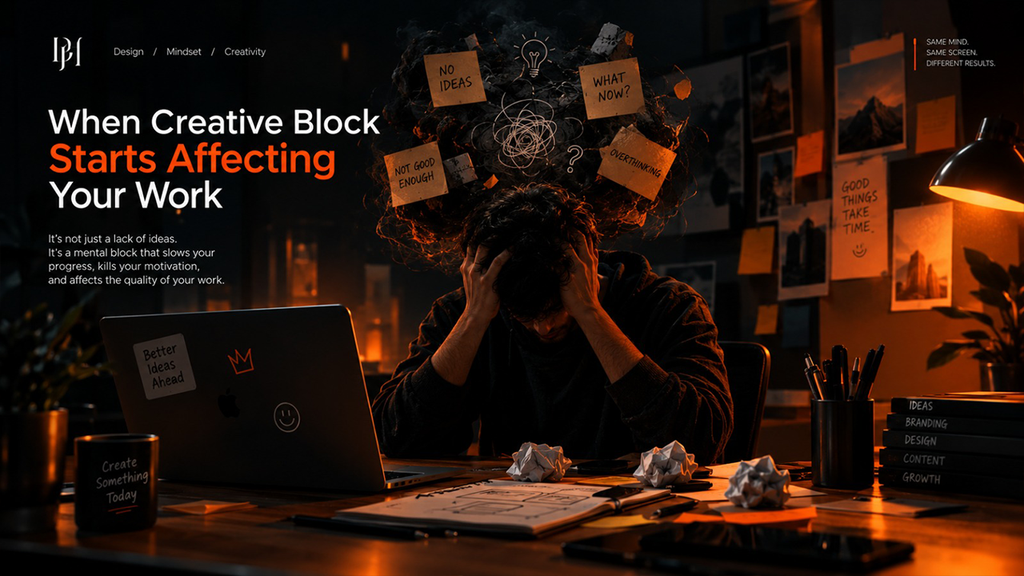
Creative block becomes much more serious when it stops being limited to personal projects.
During those two months, it started affecting client work and corporate projects too.
A task that should have taken an hour could take much longer because I was spending most of the time trying to decide what direction to take.
The worst part was knowing that I was capable of doing better.
That creates another layer of pressure.
You start thinking:
“Why can’t I do this?”
“I used to be faster.”
“Why is this simple design taking me so long?”
And those thoughts don’t usually help creativity.
They make the pressure even stronger.
I eventually realized that I didn’t need to wait for my creativity to magically return. I needed to change the way I approached creative work.
So, How Do You Prevent Creative Block?
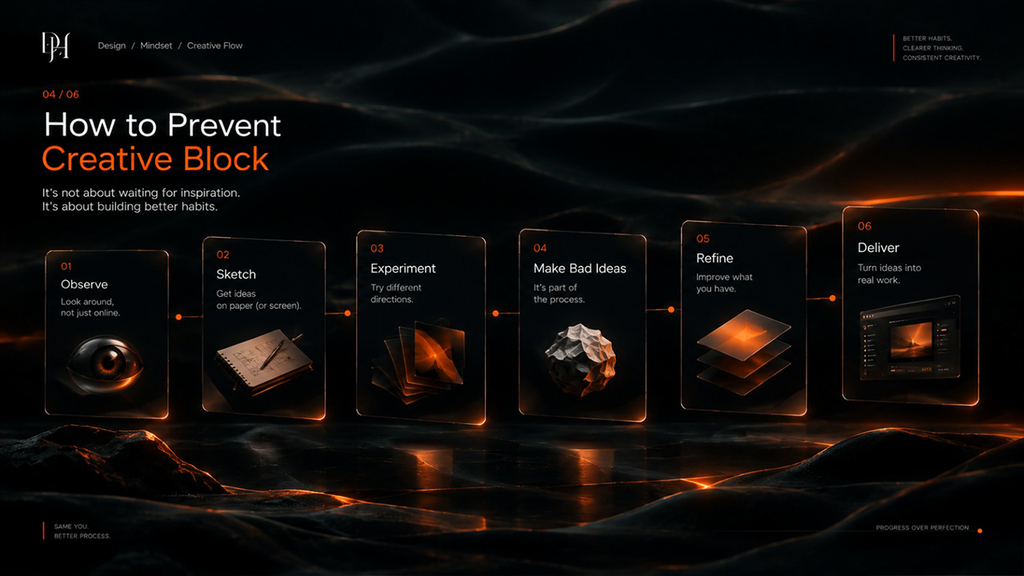
I don’t think there is a single solution that works for every designer.
But there are things I wish I had done much earlier.
1. Don’t Try to Create the Final Design Immediately
One of the biggest mistakes I made was expecting the first idea to be the final idea.
Instead, start badly.
Make a rough composition.
Put random elements on the canvas.
Try three different layouts.
Change the typography.
Move things around.
Create something that you already know isn’t good.
The goal isn’t to create a masterpiece in the first ten minutes.
The goal is to start moving.
Once something exists on the canvas, you have something to improve.
A blank canvas gives you nothing to work with.
2. Stop Looking for Inspiration When You’re Already Overloaded
When you’re genuinely stuck, opening Pinterest for another hour might not help.
Sometimes you already have enough references.
Close the tabs.
Take the references you already collected and ask yourself:
What exactly do I like about this?
Is it the composition?
The lighting?
The typography?
The negative space?
The color combination?
The photography?
Instead of collecting another 50 designs, identify the one or two things that actually caught your attention.
That turns inspiration into a design decision.
3. Break the Design Into Smaller Problems
Sometimes “design this poster” feels overwhelming.
But “choose the background” doesn’t.
Neither does “find the main image.”
Or “decide where the headline should sit.”
Instead of trying to solve the entire design at once, solve it piece by piece.
Background → Image → Typography → Layout → Details → Refinement
Suddenly, the huge creative problem becomes several small decisions.
And small decisions are easier to make.
4. Give Yourself Permission to Make Bad Work
This one sounds simple, but it’s difficult.
Designers often want every piece of work to be good.
But you can’t refine an idea that doesn’t exist.
Give yourself permission to make something ugly.
Create the bad version first.
Then create a slightly better version.
Then another.
Creative work often happens through iterations, not sudden moments of brilliance.
5. Change What You’re Doing
If you’ve been designing social media posts for six hours, don’t necessarily force yourself to create another social media post.
Try something different.
Make a random poster.
Experiment with typography.
Edit a photograph.
Create a thumbnail.
Sketch something.
Animate something.
Even if the activity has nothing to do with your current client project, it can help your brain leave the repetitive pattern it was stuck in.
Sometimes creativity comes back when you stop demanding it.
6. Build a Personal Reference Library
Instead of searching from zero every time you need inspiration, build your own library.
Save things intentionally.
You can have folders for:
- Typography
- Poster layouts
- Social media designs
- Branding
- Color combinations
- Photography
- 3D work
- Motion graphics
- Interesting compositions
- Creative advertising
But don’t just save the image.
Save why you saved it.
For example:
“I like the way the headline overlaps the subject.”
Or:
“Good use of negative space.”
This makes your reference library much more useful when you’re actually working.
7. Use AI When You’re Completely Stuck
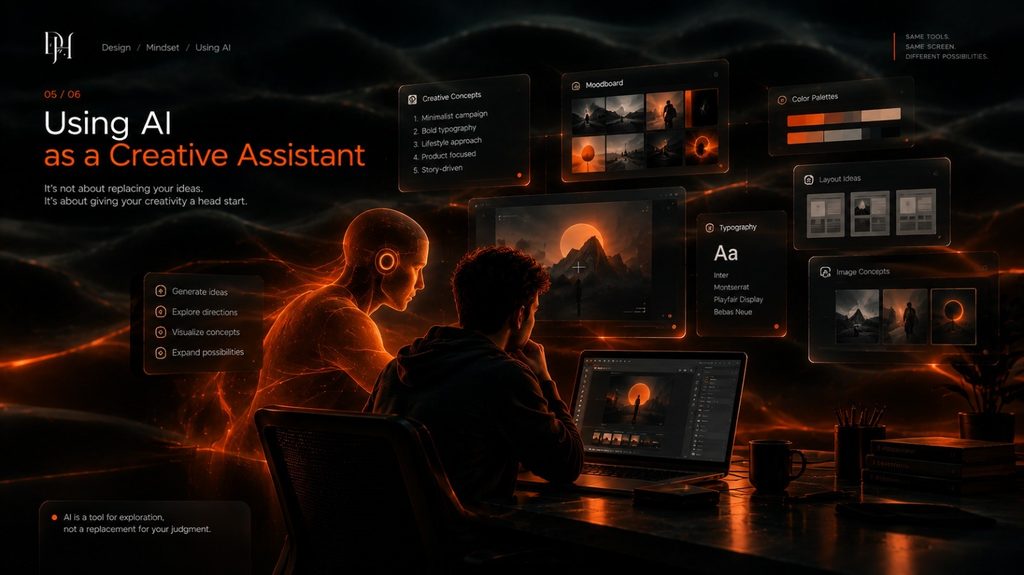
This is something that has become much more useful for designers.
AI doesn’t have to replace the designer.
For me, one of its biggest benefits is simply helping me get past the first step.
Sometimes I don’t need AI to create the final design.
I just need someone — or something — to throw ideas at me.
For example, if I’m designing a campaign for a product and have no direction, I can use AI to brainstorm:
- Different creative concepts
- Visual metaphors
- Layout directions
- Campaign ideas
- Headline variations
- Photography concepts
- Color directions
- Alternative compositions
I can then take the ideas that actually make sense and develop them myself.
AI can also be useful when you already have an idea but can’t visualize it.
You can generate rough concepts, explore different visual directions, or experiment with compositions before committing hours to the final design.
The important part is to remember that AI is a tool for exploration, not a replacement for creative judgment.
You still decide what looks right.
You still decide what fits the brand.
You still decide what communicates the message.
8. Know When You Actually Need a Break
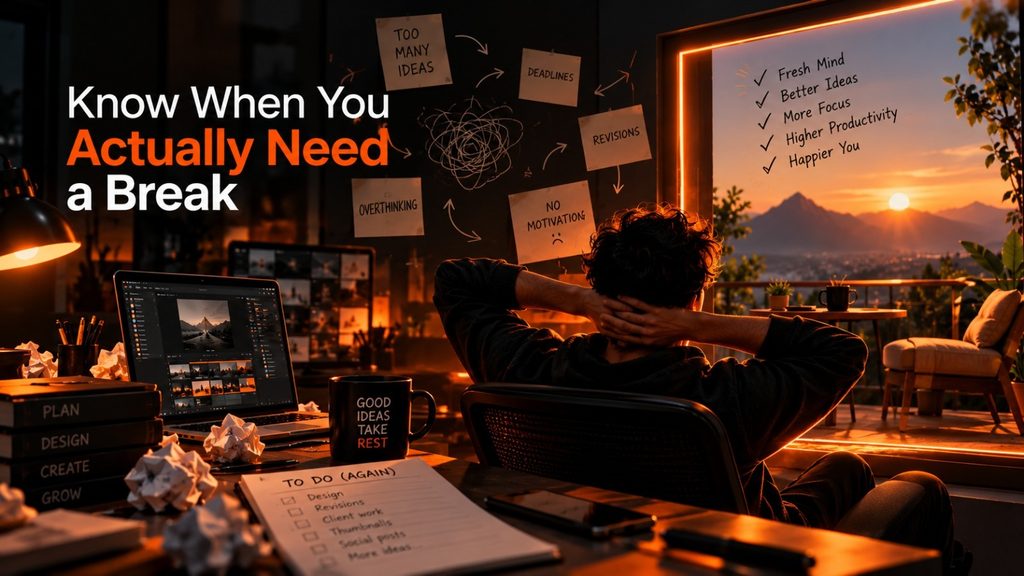
Not every creative problem can be solved by working harder.
Sometimes you’re simply tired.
And sometimes continuing to stare at the same screen for another three hours isn’t discipline. It’s just exhaustion.
Take a walk.
Get away from the screen.
Talk to someone.
Do something completely unrelated to design.
Sleep.
Come back later.
There is a difference between giving up on a project and giving your brain enough space to approach it differently.
Learning that difference can save you from a lot of unnecessary frustration.
Creative Block Isn’t Always About Creativity
Looking back at those two months, I realized something else.
Creative block isn’t always caused by a lack of creative ability.
Sometimes there are things happening outside the design process that affect how you work.
Stress.
Pressure.
Exhaustion.
Personal problems.
Uncertainty.
Too much work.
Too little rest.
You can have years of design experience and still have days when opening your design software feels impossible.
That doesn’t suddenly make you a bad designer.
It makes you human.
The important thing is recognizing when something is wrong instead of constantly blaming yourself for not being productive enough.
What I Would Do Differently Today
If I could go back to the beginning of those two months, I wouldn’t try to force myself to suddenly become creative again.
I’d start much smaller.
I’d give myself ten minutes to make something.
I’d limit the amount of inspiration I consumed.
I’d break projects into smaller decisions.
I’d create rough versions instead of waiting for perfect ideas.
I’d experiment outside client work.
I’d ask for feedback sooner.
And when I was completely stuck, I’d use the tools available to me — including AI — to generate possibilities and get the creative process moving again.
Most importantly, I wouldn’t treat every bad creative day as evidence that I had lost my ability to design.
Creativity Doesn’t Have to Arrive First
The biggest lesson I took from that experience is probably the simplest one:
You don’t always need to feel creative before you start creating.
Sometimes creativity comes after you start.
The first idea might be terrible.
The first layout might look wrong.
The first concept might get rejected.
That’s okay.
Move something.
Change something.
Try something.
Make the bad version.
Then make another one.
Eventually, something starts to click.
My two-month creative block taught me that the goal isn’t to completely eliminate creative block from your life.
That’s probably impossible.
The goal is to recognize it earlier, understand what’s causing it, and have enough tools to move through it before it takes control of your work.
Because every designer will eventually face the blank canvas.
The difference is what you do after staring at it.